Average Reviews:

(More customer reviews)Are you looking to buy Jazz Improvisation: Swing and Early Progressive Piano Styles? Here is the right place to find the great deals. we can offer discounts of up to 90% on Jazz Improvisation: Swing and Early Progressive Piano Styles. Check out the link below:
>> Click Here to See Compare Prices and Get the Best Offers
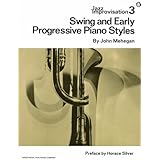
Jazz Improvisation: Swing and Early Progressive Piano Styles ReviewThis is the third in a series of four volumes created between 1959 and 1965 by jazz pianist and instructor John Mehegan. The complete set is of the utmost historical importance for anyone with a serious interest in jazz piano. Before Mehegan, no other author had succeeded in unlocking the mysteries of jazz piano and then communicating them to a mass audience in a clear and cogent manner.This volume considers three primary piano styles--first is a stride architecture using open scale tone tenth chords and modelled after pianist Teddy Wilson. The second, also stride, utilizes tenths with other notes filled in. It is modelled after Art Tatum. Third is a bebop architecture modeled after Bud Powell, in which stride is abandoned altogether and the only chord architecture is a series of comparatively naked root-third and root-seventh intervals.
(Parenthetical note: Serious Bud Powell fans may chafe to see Powell's legacy reduced to something so vastly oversimplified. However, when one is trying to communicate the revolutionary paradigm shift embodied in Powell's groundbreaking bebop work, it is difficult to incorporate his more elaborate solo piano work.
To get the best grasp of what Mehegan is talking about, particularly in the two stride styles, you should have Mehegan's second volume, Jazz Rhythm And The Improvised Line, which includes solo transcriptions for Wilson's version of Thou Swell and Tatum's legendary "Aunt Hagar's Blues." These transcriptions make it easier to see Mehegan's theoretical concepts "in action."
Be forwarned that both stride styles are technically very demanding, perhaps impossible if your hands are too small. Mehegan does a good job of breaking all the 10th intervals into three levels of difficulty and proposes viable root-seven alternatives for the most difficult ones.
The book's primary flaw -- one which persists throughout the series -- is its unfortunate allegiance to the concept of "figured bass" used within traditional music theory instruction. Indeed, there is a conspicuous overall effort throughout the series to "suck up" to academia, but this is a forgivable byproduct of an age when traditional academia persisted in viewing jazz as something too vulgar and intellectually impovershed to merit acceptance within hallowed academic environs. -- Cortland KirkebyJazz Improvisation: Swing and Early Progressive Piano Styles Overview
Want to learn more information about Jazz Improvisation: Swing and Early Progressive Piano Styles?
>> Click Here to See All Customer Reviews & Ratings Now

0 comments:
Post a Comment