Average Reviews:

(More customer reviews)Are you looking to buy A Natural History of the Piano: The Instrument, the Music, the Musicians--from Mozart to Modern Jazz and Everything in Between? Here is the right place to find the great deals. we can offer discounts of up to 90% on A Natural History of the Piano: The Instrument, the Music, the Musicians--from Mozart to Modern Jazz and Everything in Between. Check out the link below:
>> Click Here to See Compare Prices and Get the Best Offers
A Natural History of the Piano: The Instrument, the Music, the Musicians--from Mozart to Modern Jazz and Everything in Between ReviewIsacoff's, "A Natural History of the Piano," is an extraordinarily well researched and well written tribute to the instrument that has enriched Western Civilization for the past 300 years. No page has been left unturned (literally) as Isacoff weaves a poetic dance with his own flowing prose, reinforced by hundreds of resources and quotes from renowned artists, relative to the context.I thank him for introducing me to artists that, once glorious stars, have all but vanished in the kaleidoscope of time: Hazel Scott (check her out on youtube!), Art Tatum, Emil Giles, Tatiana Nikolayeva, Menahem Pressler (still alive and well at age 88), to name only a few. If it were not for this book I would never have heard of them.
Isacoff tells us that Mozart didn't set eyes on a piano until he was in his mid-twenties (which bore only a remote resemblance to the piano of today) and that he played on a piano that had a pedal-board, much like the modern organ, whose soft, loud and sustain pedals were operated by the knees pushing appropriate levers. "For the first performance of the D minor Piano Concerto, Mozart played not with two limbs but with four!" Unfathomable!
As well as many comments by prominent performing artists, Isacoff inserts several "asides" into each chapter to educate the reader, ie: the first piano was a five-octave instrument, in the late 1700's it grew into a six and a half octave piano, by the end of Beethoven's life it was seven octaves. (The modern piano extends that by three notes.) We are told the weight of the cast iron plate (300 lbs. Approx) the string tension it holds, (20 tons), the patents that marked its evolution and the makers responsible for the patents: Erard, Pleyel, Broadwood, Chickering, Steinway, etc. He clarifies the Latin origin of the word "prodigy," explaining that it means "omen," and exemplifies the many gifted artists and composers who lived short lives. He states, "...30 million children are taking piano lessons in China." (An astounding figure, but with a population of 1,339,724,852 [2011 census] this represents roughly 2.2% of the population.) These are just a few examples of the many informative "asides."
Isakoff divides artists of the piano into "Combustible," "Alchemist," "Rhythimtizer," and "Melodist." You may well be able to guess who fits where, but it is well worth the read to find out. Then we meet the Russians and Asians who presently dominate the world's pianistic stage. (Love the story of American pianist & educator Mary Hickenlooper who changed her name to Olga Samaroff, milking, as it were, the power of the Russian mystique to further her career and eventually marrying renowned conductor Leopold Stokowski.)
A most extraordinary statistic lies in the evolution of the piano competition: in 1958, the year Van Cliburn (Harvey Levan Cliburn) won the Tchaikovsky Competition, there were five international piano competitions. "Today there are 750."
Now I feel that I know everything there is to know about the piano; but as it is with coming to know the Divine, this is only the beginning.
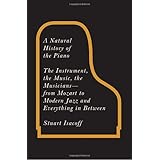
A Natural History of the Piano: The Instrument, the Music, the Musicians--from Mozart to Modern Jazz and Everything in Between OverviewA beautifully illustrated, totally engrossing celebration of the piano, and the composers and performers who have made it their own. With honed sensitivity and unquestioned expertise, Stuart Isacoff-pianist, critic, teacher, and author of Temperament: How Music Became a Battleground for the Great Minds of Western Civilization-unfolds the ongoing history and evolution of the piano and all its myriad wonders: how its very sound provides the basis for emotional expression and individual style, and why it has so powerfully entertained generation upon generation of listeners. He illuminates the groundbreaking music of Mozart, Beethoven, Liszt, Schumann, and Debussy. He analyzes the breathtaking techniques of Glenn Gould, Oscar Peterson, Vladimir Ashkenazy, Arthur Rubinstein, and Van Cliburn, and he gives musicians including Alfred Brendel, Murray Perahia, Menahem Pressler, and Vladimir Horowitz the opportunity to discuss their approaches. Isacoff delineates how classical music and jazz influenced each other as the uniquely American art form progressed from ragtime, novelty, stride, boogie, bebop, and beyond, through Scott Joplin, Fats Waller, Duke Ellington, Bill Evans, Thelonious Monk, Chick Corea, Herbie Hancock, Cecil Taylor, and Bill Charlap. A Natural History of the Piano distills a lifetime of research and passion into one brilliant narrative. We witness Mozart unveiling his monumental concertos in Vienna's coffeehouses, using a special piano with one keyboard for the hands and another for the feet; European virtuoso Henri Herz entertaining rowdy miners during the California gold rush; Beethoven at his piano, conjuring healing angels to console a grieving mother who had lost her child; Liszt fainting in the arms of a page turner to spark an entire hall into hysterics. Here is the instrument in all its complexity and beauty. We learn of the incredible craftsmanship of a modern Steinway, the peculiarity of specialty pianos built for the Victorian household, the continuing innovation in keyboards including electronic ones. And most of all, we hear the music of the masters, from centuries ago and in our own age, brilliantly evoked and as marvelous as its most recent performance. With this wide-ranging volume, Isacoff gives us a must-have for music lovers, pianists, and the armchair musician.From the Hardcover edition.
Want to learn more information about A Natural History of the Piano: The Instrument, the Music, the Musicians--from Mozart to Modern Jazz and Everything in Between?
>> Click Here to See All Customer Reviews & Ratings Now

0 comments:
Post a Comment